
The City Took Taxi. The Bronx Wants Him Back.
Taxi, the orange tabby who worked the counter at a Grand Concourse bodega for eleven years, was carried out by health inspectors on a Tuesday morning and euthanized by Wednesday.
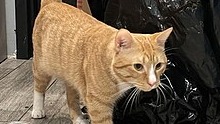
The lottery machine at Lucky Star Deli & Grocery has a dent in the top where an eleven-year-old orange cat used to sleep.
"That was his office," says Hector Reyes, 61, who has run the bodega on the Grand Concourse since 2009. "You wanted a scratch-off, you asked Taxi to move. Most people didn't ask. They just bought something else."
Taxi arrived in a cardboard box in the winter of 2015, a yellow kitten somebody left between the ice machine and the door. Reyes named him Taxi because he was the color of one and never stopped moving. By spring he had cleared the basement of mice. By summer he had his own Yelp reviews. By 2019 a Dutch tourist had put him on a postcard, and a Bronx city councilmember's office had unofficially declared him "Mayor of the 2900 block."
He never went outside. Not once in eleven years. "Why would he," Reyes says. "He had the whole store."
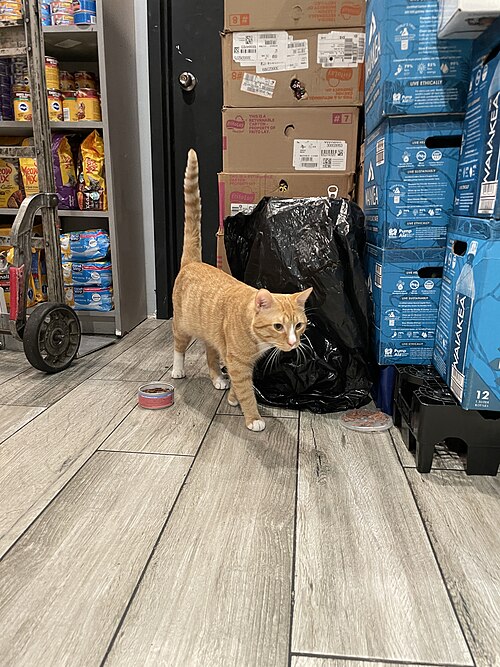
Photo: Deans Charbal / Wikimedia Commons · CC BY-SA 4.0
The first visit
The inspector came in March. A live animal in a food establishment is a violation under state agriculture rules, a fact that surprises almost everyone who learns it, because roughly every bodega in New York has a cat and always has. The fine was $300. Reyes paid it.
The inspector came back in June. Taxi was asleep on the Doritos. Another $300. Reyes paid that too, and put up a hand-lettered sign over the register: TAXI IS NOT FOR SALE AND NOT FOR SEIZURE.
"I thought that was the end of it," he says. "A fine is a fine. It's the city. You pay the city."
The Tuesday
The inspector came back on a Tuesday in September with two police officers and a plastic carrier.
What happened next exists in eleven cell phone videos, because by the time the carrier came out of the car, half the block had come out of the buildings. The footage shows a calm inspector, two uncomfortable officers, a customer named Denise holding a bag of plantain chips she never paid for, and Reyes standing in his own doorway with his arms crossed, saying one sentence over and over.
"He has never left this store."
The paperwork called it a removal for assessment. The inspector, according to the videos, said the animal would be "evaluated and returned if appropriate." Taxi, according to the videos, did not want to go into the carrier and expressed this with a single sound that one witness described as "a car alarm having a bad dream."
The crowd was quiet when the car pulled away. One man said, "They're going to bring him back, right?" Nobody answered.
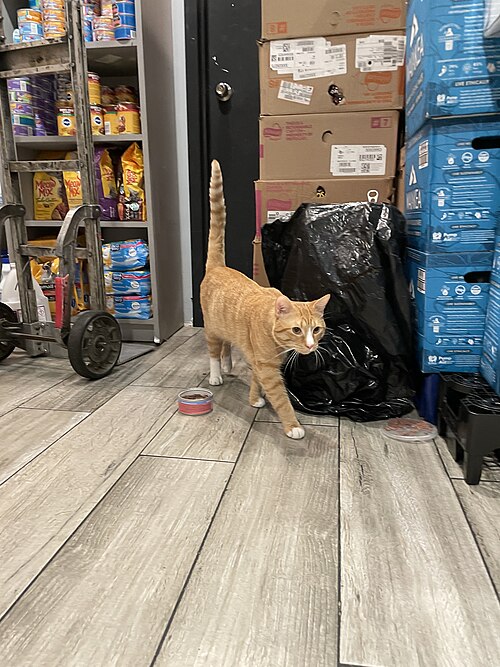
Photo: Deans Charbal / Wikimedia Commons · CC BY-SA 4.0
The Wednesday
The department's statement arrived the next afternoon, four sentences long.
The animal had scratched an inspector during transport. Protocol required rabies testing. Rabies testing of a cat cannot be done on a living cat. The animal had been "humanely euthanized in accordance with established procedure." The test was negative.
Reyes read it on his phone behind the counter. He did not say anything for a long time. Then he said, "He was never outside. Where was he going to get rabies? From the Doritos?"
The department followed up on Thursday with a second notice, informing Lucky Star Deli that a routine inspection had identified evidence of rodent activity on the premises, and that a fine would be assessed.
The block
By Thursday night there were candles on the lottery machine. By Friday there was a mural on the side of the building, a six-foot orange cat with a yellow taxi light on his head, painted overnight by three people who have asked not to be named because the wall is not theirs. By Saturday the petition had 40,000 signatures and the councilmember's office had stopped saying "unofficially."
Taxi's Law, introduced Monday, would make it legal for a food store in New York City to keep one cat, provided the cat is vaccinated, the store has a rodent problem, and the cat is "generally regarded by the community as employed there." Four co-sponsors signed on before lunch. A spokesperson for the mayor said the administration was "reviewing its position on cats," which is a sentence a spokesperson for the mayor has now said out loud.
The department has declined to comment further, citing "an ongoing review of the incident and of all current bodega cats," a phrase that has caused approximately nine thousand bodega owners to move a cat into the basement.
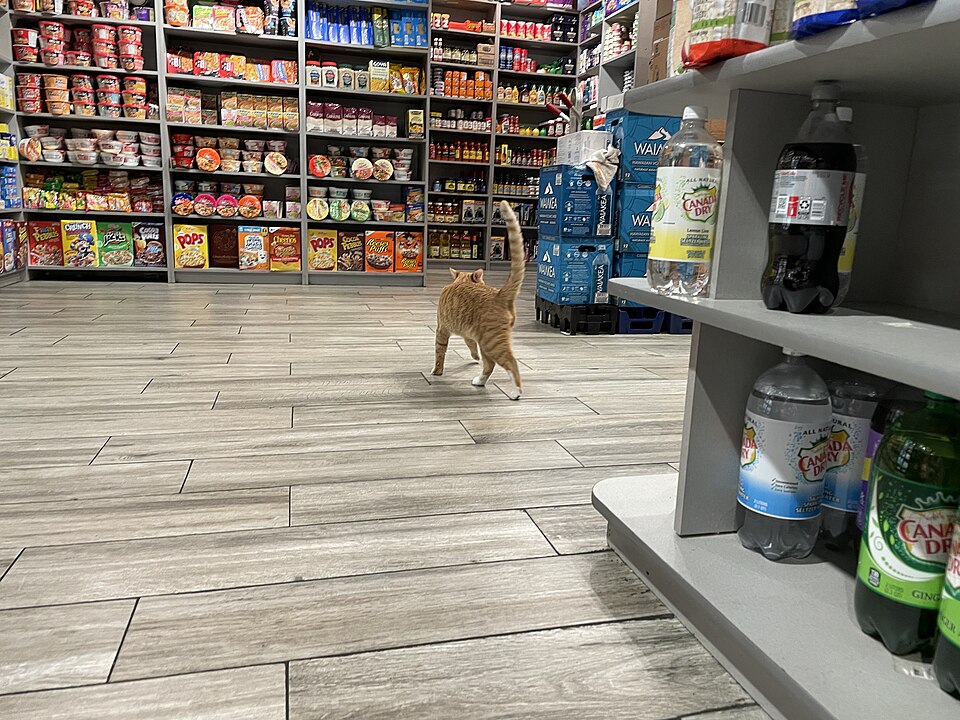
Photo: Deans Charbal / Wikimedia Commons · CC BY-SA 4.0
The carrier
Reyes still has the carrier. The department left it. It sits on the floor by the ice machine, roughly where the cardboard box was in 2015.
"People keep asking if I'm going to get another cat," he says. "I tell them it's illegal." He shrugs. "Everybody laughs. Then they look at the door like somebody's about to come through it."
Denise, the customer with the plantain chips, came back the next week and paid for them. She also brought a bag of cat food and left it on the counter without saying anything.
"If they come for the next one," Reyes says, "the whole block is going to be standing in that doorway. Let them bring a bigger carrier."
The law is real. Under New York State agriculture law, cats are not permitted in stores that sell food, and bodegas can be fined for keeping them. Thousands of them keep a cat anyway, and the city has mostly looked the other way. So far.
Photographs: a real New York bodega cat photographed by Deans Charbal, published on Wikimedia Commons under CC BY-SA 4.0.
More from New York
More More from New York →
Man who pushed his baby and her mother from a Bronx balcony arraigned from psych ward
A memorial outside Nathaly Ramirez’ Bronx building. Angel Carrasco, who shoved his infant daughter and her mother from a 15th floor balcony, appeared virtually in Bronx criminal court.

NYC secures stake in potential tech revenue with $30M investment in NYU quantum lab
Mayor Zohran Mamdani announced on Wednesday a nearly $30 million investment in a new quantum technology lab at New York University under an agreement that will give the city a share of revenue from inventions…

Grinning loon who allegedly threw girlfriend, baby from NYC balcony seen for first time in court
The lowlife monster who flashed a sinister smile after being charged with tossing his girlfriend and their 8-month-old daughter from a Bronx balcony was seen for the first time in court Wednesday — but he wasn’t…

California bullet train suffers fresh humiliation as station move branded illegal
he project is far from complete since workers broke ground on the project in 2015.